
What is SEO: The Basics
Have you ever wondered why some pages always show up first on Google and others are nowhere to be seen? That’s SEO.
What is SEO?
Search engine optimisation (SEO) is the process of improving your website and its content so that search engines, like Google, can easily find, understand and recommend it to people searching for relevant queries.
Each time someone types a keyword or question into Google, the search engine scans billions of pages to find which ones best match that query. SEO helps make sure your content is one of those top results.
For example, below are the search results for the keyword ‘best restaurants in london‘—which has 9,000 monthly searches in the UK.
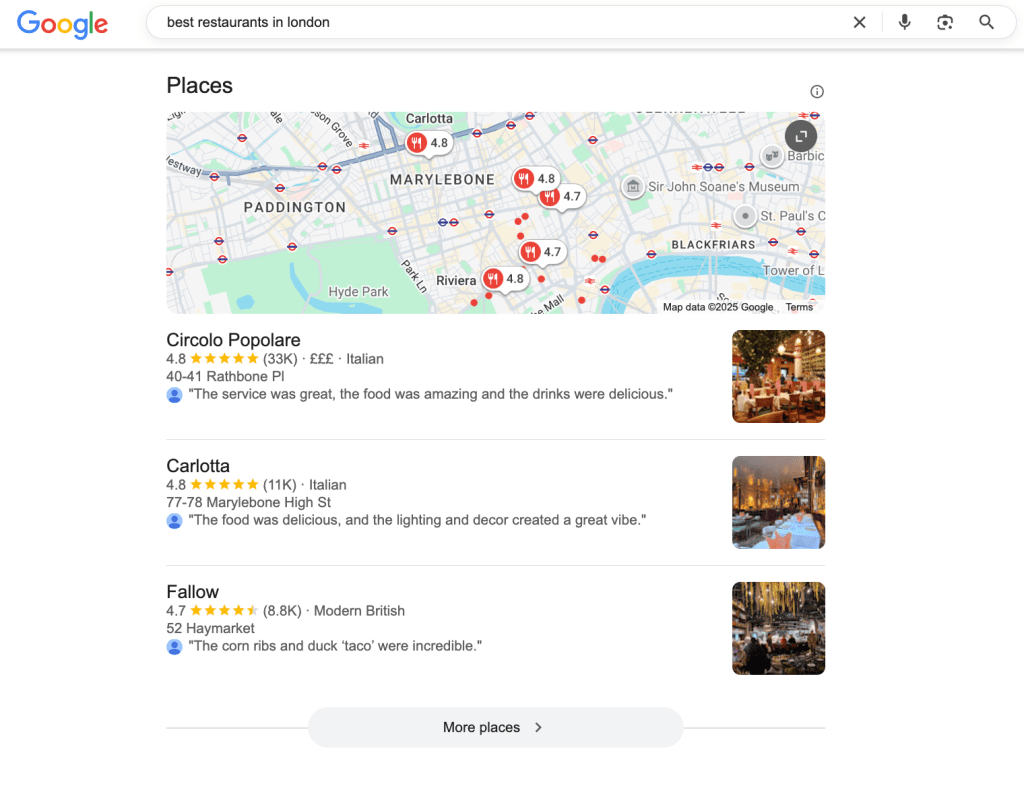
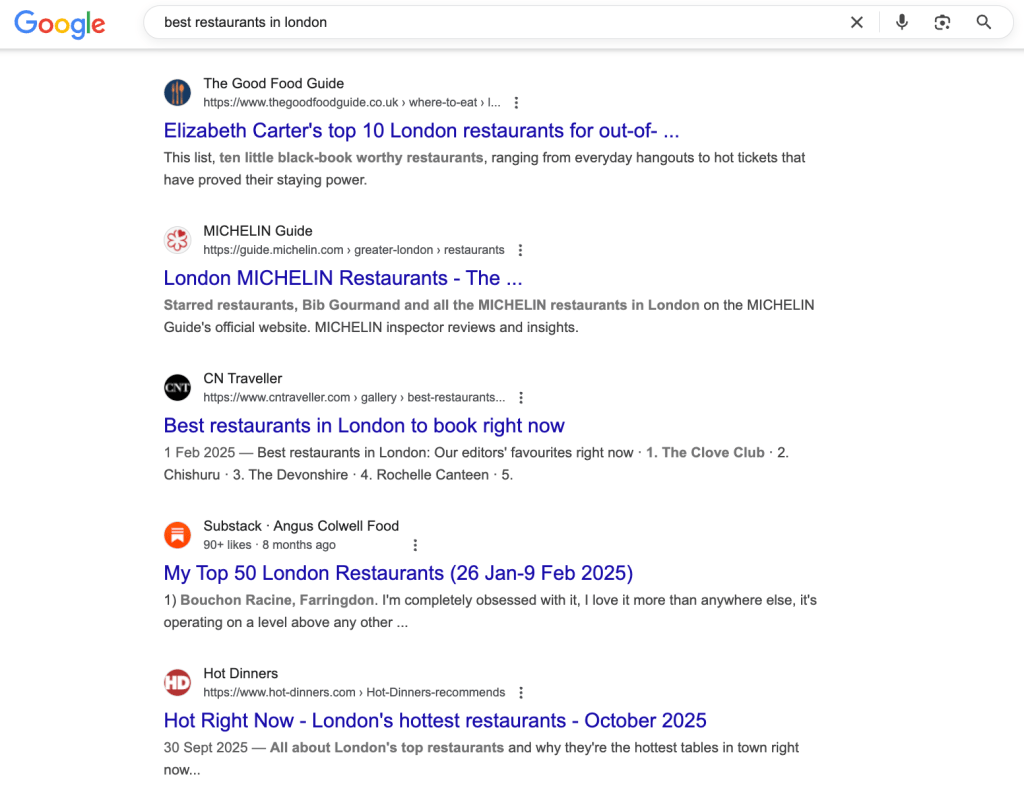
Every business or website listed above has earned its place at the top of the search results through SEO. Their content will be meticulously optimised to ensure that Google recognises it as relevant, trustworthy and useful.
Why SEO is important for businesses
Think about the last time you searched for a product, a service or some information. Chances are you probably clicked on one of the first few results. Most people do.
If your business isn’t showing at the top of the search results, users aren’t finding you. As a result, you’re potentially missing out on a huge number of leads.
When you appear at the top of the search results, people naturally see your brand as more trustworthy and reputable. That trust leads to clicks, which eventually lead to customers.
By improving your SEO, you attract visitors who are already interested in what you do. Good SEO means searchers can find you, trust you and choose you.
By investing in your SEO, you’ll benefit from:
- Increased website traffic
- Higher-quality leads
- More online enquiries or bookings
- Lower customer acquisition costs
- Increased revenue
Key components of SEO
SEO is made up of several key components that all work together to make your website perform better in the search results.
On-page SEO
On-page SEO is everything you can control directly on your website. Including:
- Content
- Keywords
- Title tags
- Meta descriptions
- Headers
- URLs
- Internal links
- Images
- Schema markup
A key part of on-page SEO is making sure your content is genuinely helpful to the reader. This is more important than ever as we also start to optimise websites for large language models (LLMs) through GEO.
Off-page SEO
Off-page SEO is any task carried out away from your own site, with the goal of increasing rankings. For example:
- Link building
- Content marketing
- Local SEO
- Social media
- Public relations
- Guest posting
Technical SEO
Technical SEO is all about optimising the ‘behind the scenes’. The key is to make sure your website loads quickly, works well on mobile, is secure and can easily be crawled and indexed by search engines.
Key elements of technical SEO include:
- Optimising site speed and performance
- Fixing broken links
- Mobile-friendliness
- Secure connection (HTTPS/SSL certificate)
- XML sitemaps and robots.txt
- Site architecture and internal linking
- Core Web Vitals optimisation
- Structured data (schema markup)
Technical SEO can make or break your website, so it’s important to get this right.
SEO content
The content on your website is often the only interaction you have with potential customers before they decide whether to trust you. Readers will get a feel for your brand through the tone, clarity and the value you provide. That first impression will make or break their decision to stay and explore your site. So make your content count.
Strong content will:
- Reflect your brand personality and tone
- Build awareness and trust amongst your customers
- Address and resolve the users search query
- Write for people first while naturally incorporating keywords for SEO
- Include optimised titles, meta descriptions and URLs
- Be updated regularly to ensure relevance.
Don’t be tempted to let AI write your content for you. It won’t do your brand any favours.
Working with an SEO content and copywriter who can get to know your brand inside out is the best way to create authentic content that is optimised for SEO and GEO.
SEO myths you might have heard
You might have heard some of these before.
SEO is dead
Wrong. SEO isn’t dead—but it is evolving rapidly due to the rise of AI-powered search.
Search engines are getting smarter, and so should your strategy.
The rise of Generative Engine Optimisation (GEO) brings a strong focus on creating valuable, user-focused content (which to be honest, we should all be doing anyway).
To stay on top of latest developments within SEO, the best places to look are the official Google Search Central Blog, or industry news sites like Search Engine Land or Search Engine Journal.
All you need is keywords
Also wrong! There’s much more to SEO than just keywords.
It’s a one-time thing
SEO is an ongoing process. Algorithms change, competitors update their sites and, chances are, your business will change with time, too. So it’s important that your SEO keeps up.
Results are immediate
Be wary of any SEO agency that promises instant results. SEO takes time to build trust with search engines and to see real lasting growth.
Ready to get started?
As a freelance SEO and content specialist, I can help you optimise your site so customers can find you.
My SEO services include on-page SEO, off-page SEO, and content & copywriting.
Get in touch to find out more.
 Evie Jones Content | Freelance SEO and Copywriting